Ireland
Wolf HallIreland is represented as a contested and expensive possession whose rebellion exposes the limits of English authority. Its place in the narrative links military planning and council politics to a wider struggle over sovereignty: the crown must defend its claim to govern the territory, while the means of doing so draw on the same administrative and political power that is reshaping the English Church.
Strategic Importance and Rebellion
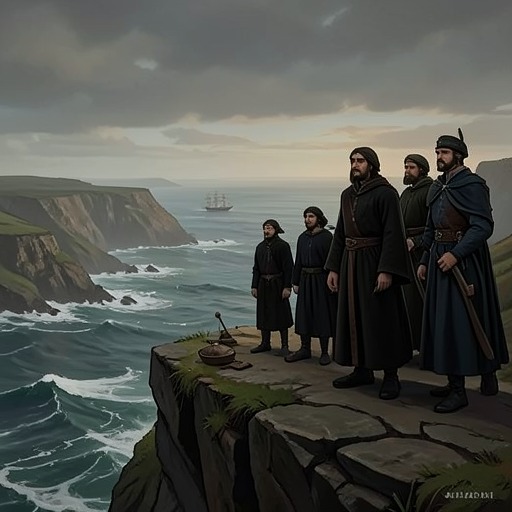
The narrative describes Ireland as being in revolt, with only Dublin Castle and Waterford holding for the king. Rebel lords offer their services and harbours to the Emperor’s troops, making the conflict more than a local challenge: intervention by an outside power could turn instability into a direct threat to English rule. The territory costs the king more to garrison than it returns, but abandoning it would leave an opening for a rival.
Cromwell’s account of Ireland emphasizes the weakness of law and the competing claims of its rulers. He characterizes the great lords as feuding and forceful, and the native chiefs as asserting ownership over land, resources, and people. These are presented as the court’s judgments about the territory, not as neutral description; the passage sets the English claim to lawful government against the coercive practices it attributes to local powers, while also acknowledging English exactions and seizure of property as causes of impoverishment.
The Council Debate
The king proposes sending the Duke of Norfolk to Ireland. Norfolk resists, saying that he has already spent enough time there and would return only if a bridge let him travel home without getting his feet wet. His refusal makes the practical difficulty of governing the territory visible within the council’s larger calculations: an assignment that appears necessary to the king is also an unwanted burden to a powerful nobleman.
Cromwell opposes Norfolk’s approach to the crisis. Rather than treating the problem solely as a campaign, he suggests sending Henry Fitzroy to Dublin as an apprentice king, making a public display and spending money to establish the crown’s presence. The proposal frames authority as something that can be staged as well as enforced. The council’s disagreement is therefore about both the use of force and the appearance of royal commitment.
Preparations and Administration
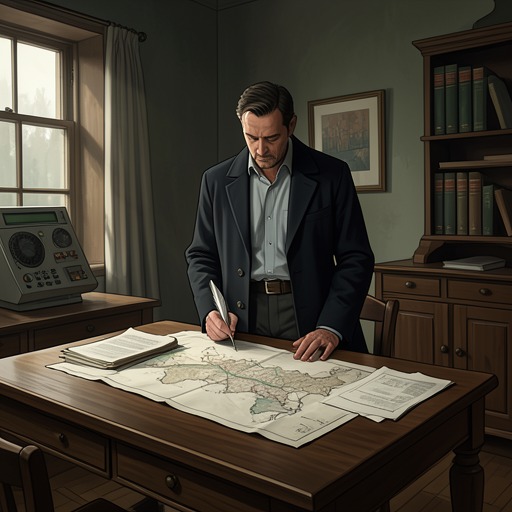
Ireland’s rebellion generates detailed logistical planning. Cromwell’s dispatch calls for cannon and iron shot, gunpowder supplies, four hundredweight of brimstone, five hundred yew bows, bowstrings, tools, axes, horseshoes, and thousands of nails. The inventory turns distant policy into a concrete administrative undertaking: the campaign depends on assembling weapons, equipment, and transport provisions, not merely on declaring the king’s intention to act.
The preparations also sit alongside negotiations and financial demands elsewhere in the kingdom. A hard summer of negotiation has produced a treaty with Scotland, while Ireland remains in revolt. The contrast shows the council managing different kinds of political pressure at once: agreement with one neighboring power does not remove the need to maintain authority in Ireland, where the costs and risks remain unresolved.
Ireland in the Politics of Rule
The Irish crisis is part of a broader argument over what the English crown may govern and how it exercises that authority. Elsewhere, Cromwell presents Parliament as the source through which a king derives kingship and argues that secular rulers, rather than church authorities, govern citizens’ temporal affairs. Ireland gives these questions a practical edge: royal claims require officials, resources, and the capacity to act across contested territory.
The narrative does not resolve the rebellion in the supplied episodes. Instead, it ends this strand with plans, equipment, and competing proposals for intervention, while the government continues to face the danger of imperial involvement. Ireland thus functions as a test of the crown’s reach: expensive to hold, dangerous to neglect, and inseparable from the novel’s account of how political authority is made effective.